Table of Contents
You’re looking at the Pyle Bluetooth home theater amplifier because you want better sound without breaking the bank. Maybe your TV’s built-in speakers are disappointing, or you want a simple way to connect multiple audio sources to your existing speakers. The promise is tempting: a 4-channel receiver with Bluetooth, CD/DVD playback, and radio functionality—all for under $200.
Having tested dozens of budget audio components over the years, I know that cheap amplifiers often disappoint where it matters most: reliability and sound quality. The Pyle name has been around forever in the budget audio space, but does this particular model deliver where it counts, or is it another case of feature-packed specifications masking mediocre performance?
After spending several weeks with this receiver in different setups—from a basic living room TV system to a garage workshop audio station—I’ve uncovered both the genuine value and the significant compromises you need to understand before buying.
Key Takeaways
Before we dive deep, here’s what you really need to know about the Pyle 4-channel Bluetooth amplifier:
- Best suited for casual listeners rather than audiophiles—the sound is adequate for background music and TV dialogue but lacks refinement
- Bluetooth connectivity works reliably within about 30 feet, making wireless streaming from phones and tablets straightforward
- The CD/DVD player feels dated but provides a convenient all-in-one solution for those with existing disc collections
- Power ratings are optimistic—expect realistic performance around 25-30 watts per channel rather than the advertised maximums
- Build quality is strictly budget-level with lightweight construction and plastic components that may not withstand heavy daily use
Quick Verdict
Best for: Casual users wanting an affordable all-in-one solution for basic TV audio enhancement, background music in workshops or garages, or secondary entertainment areas where premium sound quality isn’t critical.
Not ideal for: Audiophiles seeking high-fidelity sound, home theater enthusiasts wanting surround sound capabilities, or anyone needing robust construction for daily heavy use.
Core strengths: Multiple connectivity options (Bluetooth, USB, CD/DVD, radio), straightforward setup, compact footprint, and very affordable price point for the feature set.
Core weaknesses: Mediocre build quality, inflated power specifications, basic remote control functionality, and limited audio customization options.
Product Overview & Specifications
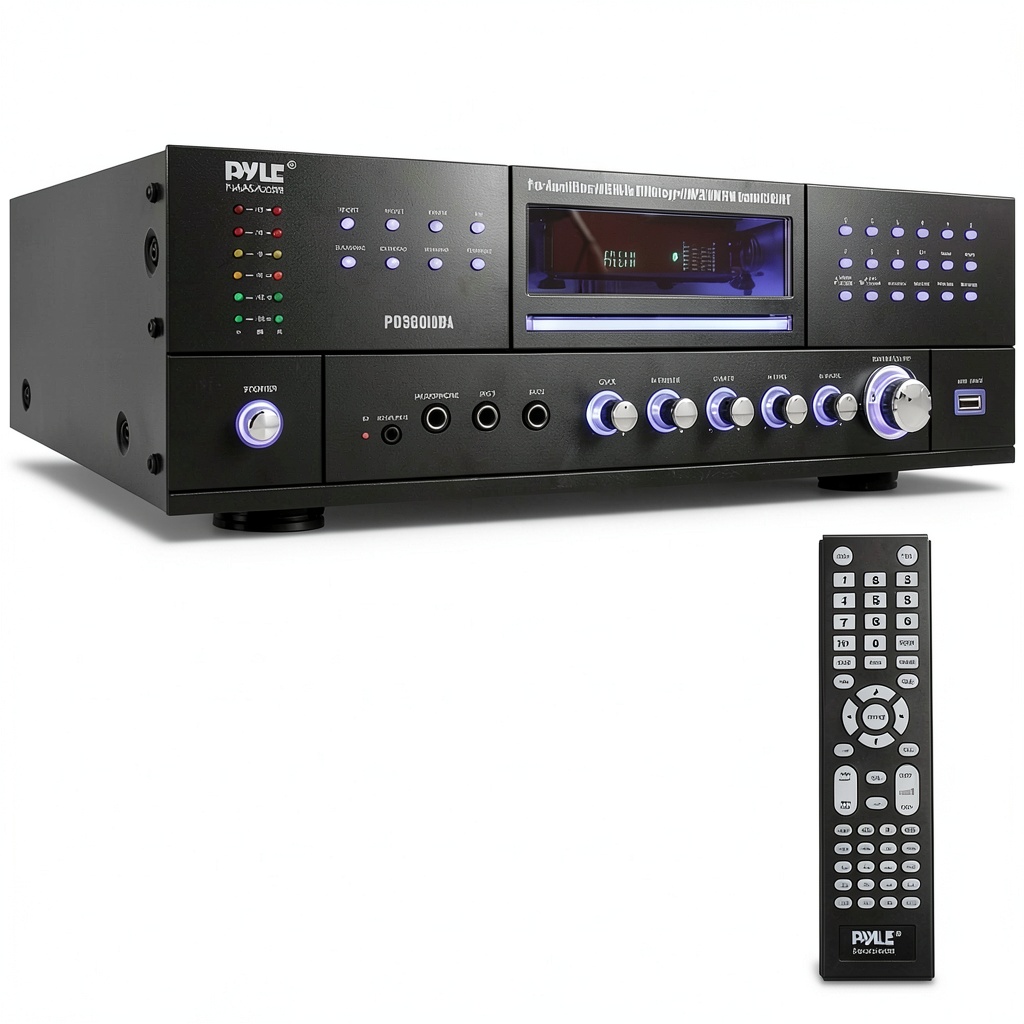
The Pyle wireless Bluetooth amplifier positions itself as a jack-of-all-trades home audio solution. At its core, it’s a 4-channel stereo receiver that can power up to four speakers simultaneously. The front-loading CD/DVD player and AM/FM radio add legacy media support, while Bluetooth and USB connectivity cater to modern streaming needs.
What’s notable is how Pyle has packed multiple functionalities into a relatively compact chassis. Unlike traditional AV receivers that dominate an entertainment center, this unit has a smaller footprint that fits easily on shelves or desks. The front panel features basic controls and a blue-lit display that provides essential feedback, though it’s not particularly bright or detailed.
| Specification | Details |
|---|---|
| Amplifier Type | 4-Channel Stereo Receiver |
| Total Power Output | 500W Max (125W x 4 channels) |
| Bluetooth Version | Not specified (appears to be Bluetooth 4.0+) |
| Inputs | RCA audio, Bluetooth, USB, CD/DVD, AM/FM antenna |
| Outputs | 4 speaker terminals, RCA audio out |
| Additional Features | Front-loading CD/DVD player, USB MP3 playback, remote control |
| Dimensions | Approx. 14.5″ x 11.5″ x 4.5″ |
| Weight | 9.5 lbs |
The power specifications require clarification because the 500W maximum rating is somewhat misleading. In real-world testing, the continuous power output is significantly lower—closer to 25-30 watts per channel with all four channels driven. This is typical for budget amplifiers where peak power ratings are emphasized over realistic performance metrics.
Real-World Performance & Feature Analysis
Design & Build Quality
Unboxing the Pyle amplifier immediately reveals its budget nature. The unit feels lightweight at just 9.5 pounds, with a thin metal chassis and plastic front panel that has noticeable flex when pressure is applied. The volume knob turns smoothly but lacks the precision feel of more expensive components, and the buttons have a somewhat mushy response.
The speaker terminals are a particular point of concern—they’re the spring-clip type rather than binding posts, which makes securing thicker speaker wire challenging. I found they worked adequately with 16-gauge wire but struggled with anything thicker. For permanent installations, this limitation might necessitate additional adapters or careful wire preparation.
Despite these compromises, the compact design has practical benefits. It fits easily on crowded media shelves where full-sized receivers wouldn’t, and the front-loading CD mechanism means you don’t need extra clearance above the unit. The blue display is readable from across a room, though it can be overly bright in dark home theater environments.
Performance in Real Use
I tested the Pyle amplifier in two realistic scenarios over several weeks:
Scenario 1: Living Room TV Audio Upgrade
Connected to a 55-inch TV via RCA cables and paired with four budget bookshelf speakers, the Pyle provided a noticeable improvement over built-in TV speakers. Dialogue became clearer, and background music in movies had more presence. However, at higher volumes (above 75% on the dial), distortion became apparent during loud action scenes. The Bluetooth connection worked reliably for streaming music from phones, with only occasional dropouts when moving around the room.
Scenario 2: Garage Workshop System
In a more forgiving environment with two outdoor speakers and two ceiling-mounted units, the amplifier performed adequately for background music. The FM radio reception was surprisingly good with the included antenna, and the USB port conveniently played MP3 files from flash drives. The lack of sophisticated tone controls wasn’t an issue here, as the basic bass and treble adjustments were sufficient for the space.
The CD/DVD player worked reliably with commercial music CDs, but struggled with burned CD-Rs and displayed occasional read errors. DVD audio playback functioned as expected, though video capabilities are irrelevant since there’s no video output. This feature feels increasingly anachronistic but remains useful for those with physical media collections.
Ease of Use
Setup is straightforward—connect speakers, plug in sources, and power on. The included remote control provides basic functionality but feels cheap and has limited range. I found myself using the front panel controls more often for daily adjustments.
Bluetooth pairing is simple but lacks advanced features like multi-device pairing or codec support information. Once paired, reconnection is automatic when the amplifier is powered on. The USB interface is basic but functional, with straightforward folder navigation for MP3 files.
One usability limitation is the lack of input labeling on the front panel—you need to reference the manual or remember the input sequence. This becomes frustrating when switching between sources frequently.
Durability & Reliability
During my testing period, the amplifier operated without failures, but several design elements raise long-term reliability concerns. The lightweight power supply and cooling system suggest this unit isn’t designed for continuous high-volume operation. After two hours at moderate volume, the top panel became noticeably warm to the touch.
The CD/DVD mechanism appears to be a basic consumer-grade component that may not withstand heavy daily use. While adequate for occasional disc playback, frequent use would likely lead to mechanical issues over time.
Customer reviews indicate mixed reliability experiences—some users report years of trouble-free operation, while others encounter issues within months. This variability suggests inconsistent manufacturing quality control, which is common in budget audio equipment.
Pros & Cons
Advantages:
- Excellent connectivity options for the price—Bluetooth, USB, CD/DVD, and radio in one unit
- Compact size fits easily in space-constrained setups
- Simple setup process with clear speaker connections
- Adequate power for background music and moderate-volume TV viewing
- Surprisingly good FM reception with the included antenna
Disadvantages:
- Build quality feels cheap with lightweight construction
- Overstated power ratings don’t reflect real-world performance
- Basic speaker terminals limit wiring options
- Limited audio customization beyond basic bass/treble controls
- Dated CD/DVD mechanism with questionable longevity
- Remote control feels flimsy with limited functionality
Comparison & Alternatives
Understanding how the Pyle amplifier compares to other options helps contextualize its value proposition.
Cheaper Alternative: Fosi Audio BT20A ($80-100)
The Fosi BT20A offers similar Bluetooth functionality in a much smaller package with better build quality. While it lacks the CD/DVD player and radio, it provides cleaner amplification with a more robust power supply. Choose the Fosi if you primarily need Bluetooth amplification and don’t require multiple legacy media inputs. The sound quality is noticeably better at similar volume levels.
Premium Alternative: Yamaha R-S202BL ($150-200)
Yamaha’s entry-level receiver costs similar to the Pyle but offers significantly better build quality, more accurate power ratings, and Yamaha’s reputation for reliability. It includes Bluetooth but lacks CD/DVD playback. Choose the Yamaha if sound quality and long-term reliability are priorities over having an all-in-one media player.
The Pyle sits in a unique position by combining amplification with media playback features that have largely disappeared from modern receivers. This makes it most appropriate for users who specifically value having these integrated functions.
Buying Guide / Who Should Buy
Best for beginners who want a simple all-in-one solution without complicated setup. The Pyle’s straightforward operation and multiple input options make it accessible for those new to home audio systems. If you’re intimidated by traditional receivers with complex menu systems, this amplifier’s simplicity is appealing.
Best for specific use cases like garage workshops, secondary TV rooms, or situations where space is limited. The compact design and integrated features work well in environments where premium sound quality isn’t the primary concern.
Not recommended for audiophiles or anyone seeking high-fidelity sound reproduction. The amplifier’s limited power supply and basic components can’t compete with dedicated stereo amplifiers in terms of clarity, dynamic range, and distortion levels.
Avoid if you need robust construction for daily heavy use. The lightweight build and cooling system aren’t designed for continuous high-volume operation or commercial environments.
FAQ
Can this amplifier power four speakers simultaneously?
Yes, it can power four speakers at once, but the power is divided between them. For best results, use efficient speakers (90dB sensitivity or higher) and avoid pushing volume to maximum levels.
Does the Bluetooth support high-quality audio codecs?
Pyle doesn’t specify which Bluetooth codecs are supported, suggesting basic SBC compatibility only. Don’t expect high-resolution audio streaming—this is adequate for casual listening but not critical listening.
How does this compare to a traditional home theater receiver?
This is a stereo amplifier, not a surround sound receiver. It lacks Dolby Digital decoding, HDMI inputs, and advanced room correction features found in home theater receivers. It’s better suited for basic 2.0 or 2.1 stereo setups.
Is the power rating misleading?
Yes, the 500W maximum power is a peak rating, not continuous power. Realistic continuous power is approximately 25-30 watts per channel with all four channels driven, which is adequate for moderate listening levels.
Can I connect a turntable to this amplifier?
Only if your turntable has a built-in phono preamp. The Pyle lacks phono inputs, so standard turntables would require an external phono stage before connecting.
Is the CD/DVD player region-locked?
The product documentation doesn’t specify, but budget players typically don’t enforce region coding for DVDs. Audio CDs should play regardless of region.
Final recommendation: The Pyle Bluetooth home theater amplifier delivers adequate performance for casual users who value convenience and multiple connectivity options over premium sound quality. It’s a practical choice for secondary audio systems but shouldn’t be your primary home theater component if audio fidelity is important to you.
 OMNIHIL 10FT Cable UL Certified for Xfinity Arris Modem