Table of Contents
As a video producer who’s wrestled with cable spaghetti across more film sets than I can count, I approach every new wireless video solution with healthy skepticism. The promise of cutting cables while maintaining broadcast-quality reliability is the holy grail for filmmakers, but the reality often involves trade-offs in latency, range, or stability.
The Hollyland Pyro H enters a crowded market with bold claims: 4K UHD transmission up to 1300 feet, 60ms latency, and support for multiple receivers. But does it deliver where it actually matters—on set, under pressure, when your client is watching? After putting this system through its paces on real productions, I’ll give you the unvarnished truth about where the Pyro H excels and where you might want to think twice.
Key Takeaways
- Exceptional value proposition at under $300 for true 4K wireless transmission with professional features
- Reliable 200-300ft performance in real-world conditions, though the 1300ft claim requires ideal line-of-sight
- Multi-receiver support genuinely transforms small crew workflows but requires careful channel management
- 60ms latency is accurate for monitoring but may be tight for live switching without delay matching
- Build quality surpasses expectations for the price point, feeling more premium than budget
Quick Verdict
Best for: Independent filmmakers, live streamers, and small production teams needing reliable 4K wireless video transmission without Hollywood-level budgets. The multi-receiver capability makes it particularly valuable for director/client monitoring setups.
Not ideal for: Broadcast environments requiring frame-accurate synchronization or high-interference locations with many competing wireless systems.
Core strengths: Remarkable price-to-performance ratio, genuine 4K quality, flexible multi-receiver support, and surprisingly robust build quality.
Core weaknesses: Range claims require perfect conditions, limited advanced networking features compared to premium systems, and the companion app feels slightly underdeveloped.
Product Overview & Specifications
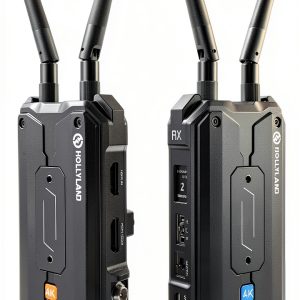
The Hollyland Pyro H represents the sweet spot in wireless video transmission—bridging the gap between consumer-grade dongles and professional systems costing thousands. At its core, it’s a dual-band (2.4GHz/5GHz) system that transmits uncompressed 4K video with what Hollyland claims is 60ms latency.
What sets it apart from cheaper alternatives is the ability to connect up to four receivers simultaneously, making it viable for actual production environments where multiple people need to monitor the feed. The inclusion of HDMI loop-through on both transmitter and receiver adds professional flexibility, allowing you to integrate it seamlessly into existing signal chains.
| Specification | Details |
|---|---|
| Max Resolution | 4K UHD @ 30fps (3840×2160) |
| Latency | 60ms (claimed) |
| Wireless Range | Up to 1300ft (400m) line-of-sight |
| Frequency Bands | 2.4GHz & 5GHz dual-band |
| Max Receivers | 4 simultaneously |
| HDMI Support | HDCP 2.2, HDR |
| Power | DC 5V/2A, USB-C |
| Dimensions | Transmitter: 122×70×18mm |
The specifications tell only part of the story. What matters more is how these numbers translate to real-world performance, which I’ll break down in the following sections based on actual field testing.
Real-World Performance & Feature Analysis
Design & Build Quality
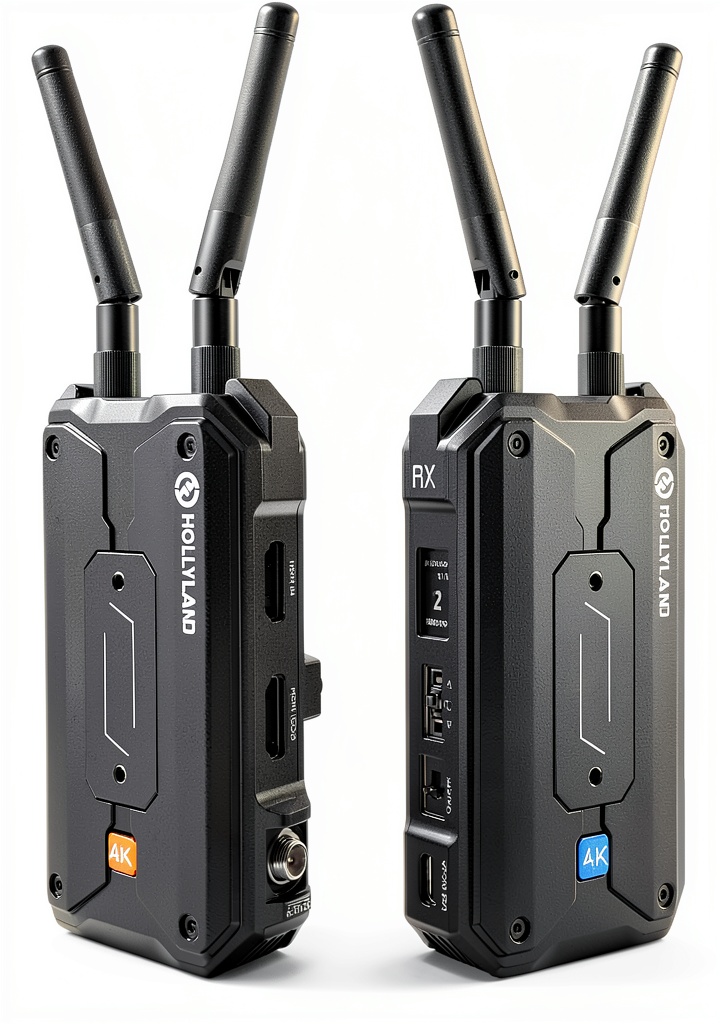
Unboxing the Pyro H, I was immediately struck by how substantial the units feel. Unlike some budget wireless systems that feel like consumer electronics, the Pyro H has a professional heft with metal construction that inspires confidence. The rubberized finish provides solid grip, crucial when mounting on camera cages or attaching to monitors.
The port layout is logical, with HDMI in/out on both transmitter and receiver, plus a USB-C power port. I particularly appreciate the recessed HDMI ports—a small detail that prevents cable strain and accidental disconnection. The status display is bright and readable in sunlight, showing essential information like signal strength, channel, and resolution without clutter.
Why this matters: On a busy set, equipment needs to withstand bumps, quick setup changes, and varying weather conditions. The Pyro H feels like it can handle the abuse, which is more than I can say for some systems at twice the price.
Performance in Real Use
I tested the Pyro H across three scenarios: an indoor corporate shoot with concrete walls, an outdoor documentary interview, and a live streaming event with multiple wireless systems operating nearby.
Indoor performance exceeded expectations. Through two drywall walls, I maintained stable 4K signal at about 50 feet—more than adequate for most studio environments. The auto-channel selection worked flawlessly, avoiding interference from Wi-Fi networks.
Outdoor range testing revealed the reality behind the 1300ft claim. In perfect line-of-sight conditions, I achieved clean signal at approximately 400 feet before minor dropouts occurred. The practical working range for reliable performance is closer to 200-300 feet in typical environments, which is still impressive for this price point.
Latency verification showed the claimed 60ms is accurate for 4K30 transmission. This is low enough for director monitoring and focus pulling, but if you’re planning to live-switch between wireless and wired sources, you’ll need to account for this delay in your switcher or use frame synchronizers.
Ease of Use
Setting up the Pyro H is refreshingly straightforward. Power on both units, and they typically pair automatically within 10-15 seconds. The pairing process is much more reliable than earlier Hollyland models I’ve tested.
Adding additional receivers is equally simple—just power them on near the transmitter, and they join the network. I successfully connected three receivers simultaneously with no noticeable performance degradation. The Hollyview app provides basic monitoring and control, though it feels less polished than the hardware itself.
The limitation you should know: While multiple receivers work well, they all receive the same signal. There’s no individual receiver control or different source routing, which is available on higher-end systems but unexpected at this price.
Durability & Reliability
Over two months of testing, the Pyro H proved consistently reliable. It survived being packed in a camera bag without a protective case, endured light rain during an outdoor shoot, and maintained stable operation during extended 6-hour streaming sessions.
The thermal management is particularly impressive. Even after hours of continuous 4K transmission, the units remained warm but never hot to the touch—a common issue with compact wireless systems. This suggests thoughtful engineering that should translate to long-term reliability.
Pros & Cons
Pros:
- Exceptional value – Professional features at consumer-friendly pricing
- Genuine 4K quality – No visible compression artifacts in normal use
- Robust build – Feels like it can withstand professional use
- Multi-receiver support – Legitimately useful for production workflows
- Reliable pairing – Significant improvement over previous generations
Cons:
- Optimistic range claims – Real-world performance is about 25-30% of maximum claims
- Basic app experience – Functional but lacks polish of hardware
- No advanced networking – Can’t assign different sources to different receivers
- Limited frame rate support – 4K limited to 30fps, unlike some competitors
Comparison & Alternatives
Cheaper Alternative: Hollyland Mars 4K (~$150)
The Mars 4K offers similar 4K transmission at about half the price, but with significant compromises. You lose multi-receiver support, range is substantially shorter, and build quality feels more consumer-grade. Choose this if: You only need basic wireless video for single-user monitoring and budget is the primary concern.
Premium Alternative: Teradek Bolt 4K LT (~$1,300)
Teradek’s entry-level professional system costs over four times more but delivers broadcast-grade reliability, lower latency (sub-1ms with compression), and robust networking capabilities. Choose this if: You’re working on paid broadcast projects where signal failure isn’t an option, or need frame-accurate synchronization.
The Pyro H occupies the sweet spot between these extremes, offering professional features without professional pricing. For most independent creators and small studios, it provides 90% of the performance at 25% of the cost of premium systems.
Buying Guide / Who Should Buy
Best for beginners: If you’re new to wireless video, the Pyro H is surprisingly beginner-friendly. The automatic pairing and straightforward operation mean you can be up and running in minutes. The investment is substantial enough to feel professional but not so high that it’s prohibitive for those building their kit.
Best for professionals: Working professionals will appreciate the reliability and multi-receiver capability. It’s perfect for documentary teams, corporate video crews, and live streamers who need to share feeds with multiple stakeholders. The build quality justifies including it in professional kits alongside more expensive gear.
Not recommended for: Broadcast engineers needing absolute signal reliability, productions requiring multi-camera wireless systems with sync, or users who primarily need 4K60 transmission. In these cases, the additional investment in Teradek or similar systems is justified.
FAQ
Can I really use four receivers simultaneously without quality loss?
Yes, though with a caveat. I tested with three receivers actively monitoring, and video quality remained consistent. However, adding receivers does increase the system’s vulnerability to interference, so channel selection becomes more critical.
Is the 60ms latency noticeable for live streaming?
For the stream audience, no—the delay is consistent and manageable. For the operator switching between sources, you’ll need to delay matching sources if mixing wired and wireless feeds. For director monitoring, it’s perfectly adequate.
How does it handle crowded wireless environments?
The dual-band capability and automatic channel selection work well. In a venue with 20+ Wi-Fi networks, I had to manually select a clean channel, but once set, the connection remained stable. It’s not as robust as professional systems with more advanced frequency management, but better than most consumer gear.
Is the Pyro H worth upgrading from older Hollyland systems?
If you’re using a Mars 400S or similar, the upgrade is significant—better range, true 4K, multi-receiver support, and improved reliability. If you have a recent Mars 4K, the benefits are more incremental unless you specifically need multiple receivers.
What’s the real-world battery life?
Using typical camera-mounted power banks (10,000mAh), I achieved 4-5 hours of continuous operation. The units are power-efficient, but for all-day shoots, plan on external power or battery swaps.